

In a light misting rain the morning of Sunday, May 3, 2009, Pat Gilleadeau, NP, a nurse practitioner with Dr. James Krueger’s research team, and five members of the Center for Clinical and Translational Science (CCTS) Recruitment and Outreach Support Service attended the National Psoriasis Walk for Awareness at the New York Botanical Garden in the Bronx. The Rockefeller team joined over 450 volunteers to walk among the azaleas and raise money for the cause, while educating patients and their families about clinical translational research and psoriasis research at the Rockefeller University Hospital. More than 130 volunteers and patients stopped at the Rockefeller booth to hear about studies, and receive Rockefeller promotional items and literature; a subset filled out comment cards asking to be contacted regarding information about research studies. From left to right: Suzanne Ouyang, Angela Campbell, Anne Tam, and Patricia Gilleaudeau
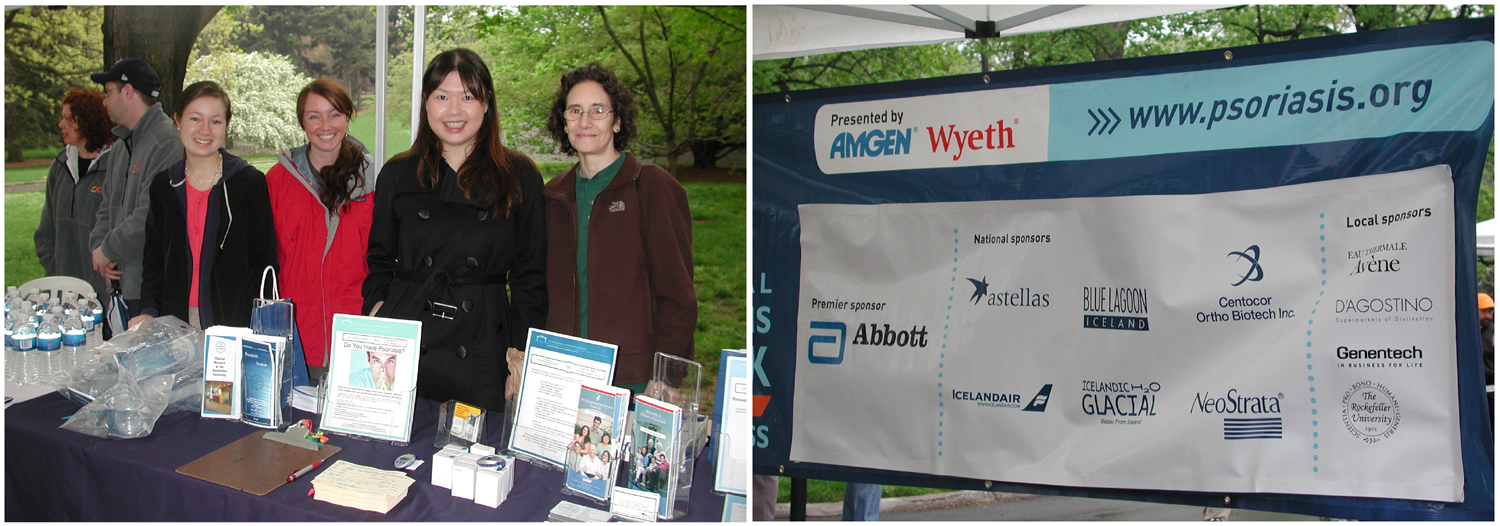
The Walk for Awareness event, organized by the National Psoriasis Foundation and co-sponsored by Rockefeller University Hospital, was one of many new initiatives undertaken by the recruitment team to raise visibility for the CCTS, educate the public about research at Rockefeller, and enhance participation in clinical studies. In the past year, the Recruitment team has participated in health, community, and street fairs across the city, such as the East Sixties Neighborhood Association street fair, the Diabetes Expo held at the Javits Center, the Isaacs Beacon community fair, and the Hunter College health fair.
Since the Clinical and Translational Science Award (CTSA), the resources and expertise provided to researchers by the Recruitment and Outreach Support Service have been significantly enhanced, including centralization of professional services that have dramatically increased the speed and success of enrolling participants into studies. The greatest impact derives from: 1) early involvement of the recruitment team during protocol design to assess recruitment feasibility and develop a protocol-specific strategy; 2) professional graphic design and advertisement placement to better reach target populations; 3) centralized incoming-call management through 1-800-RUCARES to capture demographics and database enrollment, pre-screen volunteers for one or more specific studies, and manage referrals to coordinators and clinic appointments. These efforts have resulted in a doubling in the size of the IRB-approved Research Volunteer Repository (listing of volunteers who have consented to be called in the future for additional studies), smooth and consistent enrollment of appropriately diverse, eligible subjects for most research studies; and dramatic and rapid enrollment successes for some investigators using the service.
Dr. Andreas Mauer’s study to test and validate a bleeding history phenotyping questionnaire (AMA-0637) has been enrolling at a record pace. Since October, the CRSO has referred more than 350 volunteers to this study, and many were pre-screened and directly scheduled for clinic appointments; more than half of his target enrollment of 500 completed the study at the time of this writing. Dr. Peter Schlegel’s pilot study on MENT (7á-Methyl-19-Nortestosterone), a male contraceptive gel, was fully enrolled with six participants within two months of the recruitment start date. As reported in a previous e-Newsletter, the recruitment team helped Dr. Lisa Hudgins to initiate and complete enrollment of her fructose utilization study – including four day-long metabolism study visits—in less than six months. In addition to indentifying potential participants, the prescreening process also contributes to excellent retention rates, with study investigators reporting extremely low attrition and high compliance.
In the past year the Recruitment service has conducted more than 20 comprehensive recruitment consultations and has produced and run 30 print ads, more than 100 online ads, and two radio ad campaigns. These ads have been run in print publications such as AM New York, Metro, Our Town, and West Side Spirit; online sites such as Craigslist.org, Centerwatch.com, and Backpage.com; and radio stations such as 1010WINS and LiteFM. The Recruitment Office has also posted and distributed hundreds of flyers and coordinated targeted mailings to practitioners for numerous studies. The service has provided more than $30,000 to investigators in cost-sharing support of recruitment activities.
The calls to 1-800-RUCARES in response to targeted advertising represent a diverse population of interested volunteers. Of callers who provided their race during call-back interviews (some decline), 25% were Black or African American, 6% were Asian, 30% were White or Caucasian, and the remainder were mixed, Native American, Native Hawaiian or Pacific Islander, or other. Approximately 16% of referred volunteers who provided their ethnicity described themselves as Hispanic. The demographics of New York City are well represented in the populations reached by Recruitment Service efforts.
Looking ahead, the CRSO’s Recruitment Service is working with Information Technology to bring online a Recruitment Assistant module in Integrated Research Information System (iRIS). The Recruitment Assistant would provide integration of the Recruitment Service database with the iRIS Study Management database affording one-time central capture of demographic and enrollment status information visible to recruitment and study team members. The CRSO will work with research study coordinators, principal investigators, and others involved in study enrollment to use the new program.
To schedule a recruitment consultation or for help with the creation and placement of advertisements, please contact Caryne Roey, Clinical Research Recruitment Specialist, at croey@rockefeller.edu or go to http://clinfo.rockefeller.edu/recruitment/.
- About
- Training Programs
- The Rockefeller University Hospital
- Research Resources
- Community Engagement
- Collaborating Institutions
- Faculty
- Research Protocols
- e-Newsletter
- IRB
-
The Rockefeller University Center for Clinical and Translational Science is supported, in part, by a Clinical and Translational Science Award (CTSA) from the National Center for Research Resources and the National Center for Advancing Translational Sciences (NCATS), part of the National Institutes of Health.

June 1, 2009
Recruitment Outreach and Support Service Hitting Its Stride
By Caryne Roey and Rhonda Kost, M.D.



The Rockefeller University | 1230 York Avenue, New York, NY 10065 | 212-327-8000
Copyright © 2004–2026
The Rockefeller University. All rights reserved.
Contact |
Comments |
Site Map |
Copyright Complaints